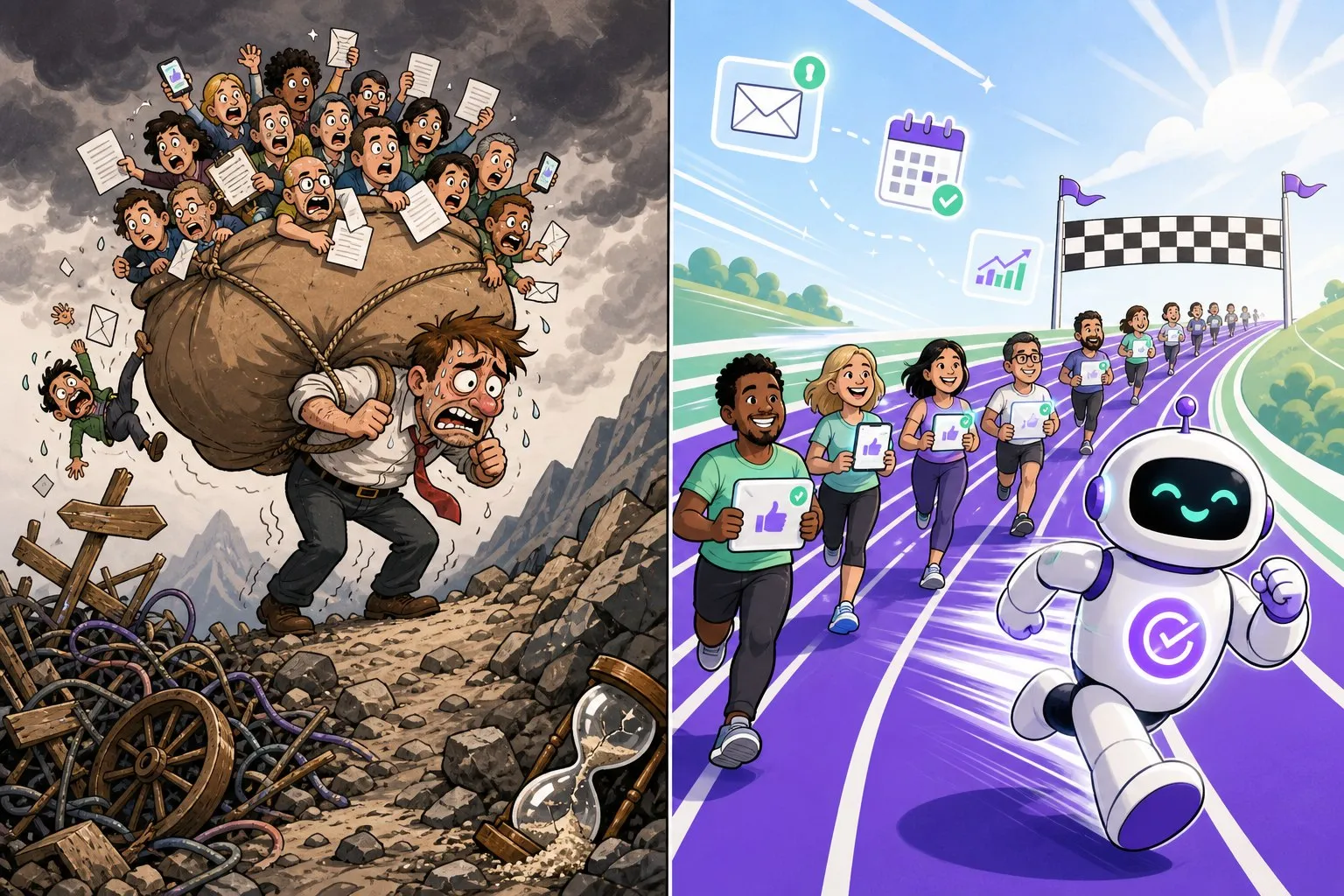
Short answer: You don't need 40 tools. You need five automated workflows running on a platform you'll actually use. Welcome, cart recovery, post-purchase, browse abandonment, and win-back. Build them in that order and you'll capture most of the email revenue available to a small business.
Every "best email marketing software 2026" article gives you a list of 22 platforms with the same copy. None of them tell you what to actually build. This article is the opposite: five workflows, real benchmarks, the order to set them up, and a routing table to pick your tool in 60 seconds.
No time to build this yourself? Fismbot's Email Pilot writes and personalises the campaigns for you, and our done-for-you marketing team can set up all five flows end to end.
The one number that should change how you think about email
Email flows account for a disproportionate share of revenue. Klaviyo reports that email flows generate nearly 41% of email revenue from just 5.3% of sends. Five and a half percent of your emails do forty percent of the work — because they're triggered by behaviour instead of blasted on a schedule.
That's the entire argument for automation. You're not sending more email. You're sending the right email at the moment the intent is highest, without a human pressing send.
Behaviour-triggered flows outperform broadcasts by an order of magnitude.

Watch (6 min): Email Automation Tutorial for Beginners — How to Automate Email Marketing in 2026 — a plain walkthrough of building your first two flows.
The 5 workflows, in the order you should build them
1. The Welcome Series — build this first
What it is: A 3–5 email sequence triggered the moment someone subscribes, spread over roughly 7 days.
Why it's first: Welcome emails have the highest open rate of any automation — around 50% — and automated welcome emails benchmark near 35% open, 3.9% click, 2.1% conversion. People who just subscribed are paying attention. Most small businesses waste that attention with a single "thanks for subscribing" email.
What to include:
- Email 1 (immediate): Deliver the thing you promised. Set expectations for what's coming.
- Email 2 (day 1–2): Your story or the problem you solve. Build the why.
- Email 3 (day 3–4): Social proof — a review, a result, a case study.
- Email 4 (day 5–7): The offer. Now is when a discount belongs — not in email one.
Target benchmarks: 40–60% open, 10–25% click. If you're under, it's your subject lines or your deliverability, not your list.
The mistake to avoid: Leading with a discount. If every welcome email starts with 10% off, you train your list to wait for discounts and to ignore you otherwise.
Want the copy written for you? Post Pilot handles social content the same way — tell it about your business once and it writes on-brand posts continuously.
2. Cart Recovery — highest immediate ROI
What it is: A 3-email sequence triggered by an abandoned checkout, sent over about 3 days.
Why it's second: Roughly 75% of online carts are abandoned, and cart recovery directly recovers money you were already about to lose. There's no other automation with a payback period this short.
What to include:
- Email 1 (~1 hour later): Simple reminder. No discount. Many people just got distracted.
- Email 2 (~24 hours): Address the objection — shipping, returns, sizing, guarantee.
- Email 3 (~48–72 hours): The incentive, if you use one. Last email only.
Target benchmark: Recover at least 10% of lost sales. Top performers hit 15%+.
The mistake to avoid: Discounting in email one. You'll pay for carts that would have converted anyway.
Cart recovery is the fastest-payback automation most small businesses can build.

Watch (8 min): How to Set Up Email Marketing Automation for FREE — Beginner Guide 2026 — step-by-step cart recovery and welcome flow setup.
3. Post-Purchase Sequence — build retention, not just sales
What it is: A 4–5 email sequence after someone buys.
Why it's third: Acquisition gets the attention; retention pays the bills. A post-purchase flow reduces buyer's remorse, generates reviews, and sets up the next purchase.
What to include:
- Email 1: Order confirmation + what happens next (set expectations clearly).
- Email 2 (day 3–5): How to get the most from what they bought. Genuinely useful.
- Email 3 (day 7–10): Review or feedback request — timed to when they've actually used it.
- Email 4 (day 14+): Cross-sell or complementary product.
- Email 5 (day 30+): Referral or loyalty invite.
Target benchmark: Progressive engagement increase across the sequence leading to repeat purchase.
The mistake to avoid: Asking for a review on day one. Let them use the product first.
4. Browse Abandonment — capture mid-funnel intent
What it is: A 2–3 email sequence triggered when someone views a product or key page but doesn't add to cart.
Why it's fourth: This is warmer than a cold subscriber but cooler than a cart abandoner. It's mid-funnel, and most small businesses skip it entirely.
What to include:
- Email 1: "Still thinking about it?" with the item they viewed.
- Email 2: Related products, reviews, or comparison content.
- Email 3 (optional): Light incentive if the item is high-margin.
Target benchmark: Lower conversion than cart recovery, but far higher than broadcast. The value is in the volume — more people browse than add to cart.
The mistake to avoid: Being creepy about it. "We noticed you looked at this" is fine. "We saw you on our site at 11:47pm" is not.
5. Win-Back / Re-engagement — protect your deliverability
What it is: A 3-email sequence over ~30 days targeting subscribers who haven't engaged in 60–90 days.
Why it's fifth: It's last in revenue impact but first in list health. Sending to dead contacts tanks your deliverability for everyone. Win-back either reactivates them or tells you to suppress them.
What to include:
- Email 1: "We miss you" + what's new since they last engaged.
- Email 2: A genuine reason to return — new product, exclusive offer.
- Email 3: The honest one. "Should we stop emailing you?" with a one-click yes.
Target benchmark: Reactivate a meaningful slice; suppress the rest. Removing non-openers is a win, not a loss.
The mistake to avoid: Never cleaning your list. If someone hasn't opened in 6 months, they're not a subscriber — they're a deliverability liability.
Related: Can Your Agency Legally Resell n8n? — if you're building these flows for clients rather than for yourself, read the licence rules first.
List hygiene is a deliverability decision, not a vanity metric decision.

Watch (12 min): Email Marketing Tutorial for Beginners 2026 — covers list building, subject lines, and your first automation end to end.
Which tool? The 60-second routing table
Stop reading 22-tool listicles. Find your row instead.
| If you are… | Pick | Why | Starting price |
|---|---|---|---|
| Brand new, tiny list, tight budget | Brevo | Generous free tier, huge contact limits even on cheap plans | ~$8–9/mo |
| Ecommerce / online store | Omnisend or Klaviyo | Built for cart flows, product feeds, SMS | ~$16/mo |
| Need deep automation branching | ActiveCampaign | Unmatched automation depth at the entry price | ~$15/mo |
| Simplest possible, just want automation | MailerLite | Cleanest UX, affordable, does the five flows well | ~$12/mo |
| Newsletters + monetisation | beehiiv | Built for publishing and growth | ~$43/mo |
| All-in-one (funnels, courses, webinars) | GetResponse | Broader toolkit beyond email | ~$15/mo |
How to decide in practice: For most small businesses that aren't ecommerce, MailerLite or Brevo. For ecommerce, Omnisend or Klaviyo. Only go ActiveCampaign if you genuinely need complex branching — otherwise the power becomes overhead you pay for and never use.
If you'd rather skip the tool-selection process entirely, Email Pilot bundles AI writing, personalisation, template building and campaign analytics into one $51/month plan — no separate platform to configure.
Pick the tool you'll actually use. Sophistication you don't use is just cost.

The 30-day implementation plan
You can have all five flows live in a month. Here's the order:
- Week 1: Set up your platform, import and clean your list, fix authentication (SPF, DKIM, DMARC). Build the welcome series.
- Week 2: Build cart recovery (if ecommerce) or browse abandonment. Test with your own email address first.
- Week 3: Build post-purchase. Add review requests.
- Week 4: Build win-back. Set your suppression rule (e.g. no opens in 90 days → sunset sequence).
- Ongoing: Review metrics monthly. Test subject lines. Clean quarterly.
Critical prerequisite most people skip: Authenticate your sending domain before you build anything. SPF, DKIM, and DMARC configured correctly is the difference between landing in the inbox and landing in spam. No amount of clever copy survives a deliverability problem.
Not sure what it's worth? Fismbot's services page has a savings calculator that compares automation against a traditional agency retainer.
FAQ
How many email automations does a small business actually need?
Five, done well. Welcome, cart recovery (if ecommerce), post-purchase, browse abandonment, and win-back. Everything else is a refinement of those.
What's the cheapest way to start?
Brevo's free tier covers automations for up to 2,000 contacts, and MailerLite has a free plan for small lists. Neither costs you anything until you grow.
Do I need a marketing hire to run this?
No. These five flows are build-once, run-forever. The ongoing work is reviewing metrics monthly and refreshing creative.
How long until I see results?
The welcome series and cart recovery show results within days of going live. Win-back and post-purchase compound over months.
What if my emails land in spam?
Authenticate your domain first (SPF, DKIM, DMARC). Then warm up gradually, keep your list clean, and avoid spam-trigger language. Deliverability is a hygiene problem before it's a copy problem.
Should I use AI to write the emails?
Use AI for the first draft and the subject line variations — then edit for voice. Never let AI output go out unedited; generic voice kills engagement. That's exactly what Email Pilot solves — it generates campaigns from your brand voice and audience data, with every section editable before it sends.
The bottom line
Email marketing automation isn't about having the most tools. It's about having five flows that run without you, on a platform you'll actually log into.
Build them in order. Benchmark them honestly. Clean your list. That's the whole game.
Want it built for you? Fismbot's Email Pilot creates and personalises campaigns that convert — or let our done-for-you team set up all five flows for your business. Start with a consultation.
Curious how this compares to going the traditional route? See why businesses choose Fismbot over agency retainers — or join the newsletter for weekly automation breakdowns.
Sources
- eCommerce Email Marketing: The Complete 2026 Guide — FluentCRM
- Ecommerce Email Automation Types, Examples, and Tips (2026) — Shopify
- The Welcome Email Sequence: A 2026 Onboarding Framework — Digital Applied
- Email Automation Sequences That Convert: Complete Guide 2026 — TrueFuture Media
- 18 Cheapest Email Marketing Platforms Compared (2026) — Brevo
- 16 Best Email Marketing Platforms 2026 — Email Vendor Selection
Last updated: September 2026. Benchmarks are industry averages — your results will vary by list quality, offer, and industry.