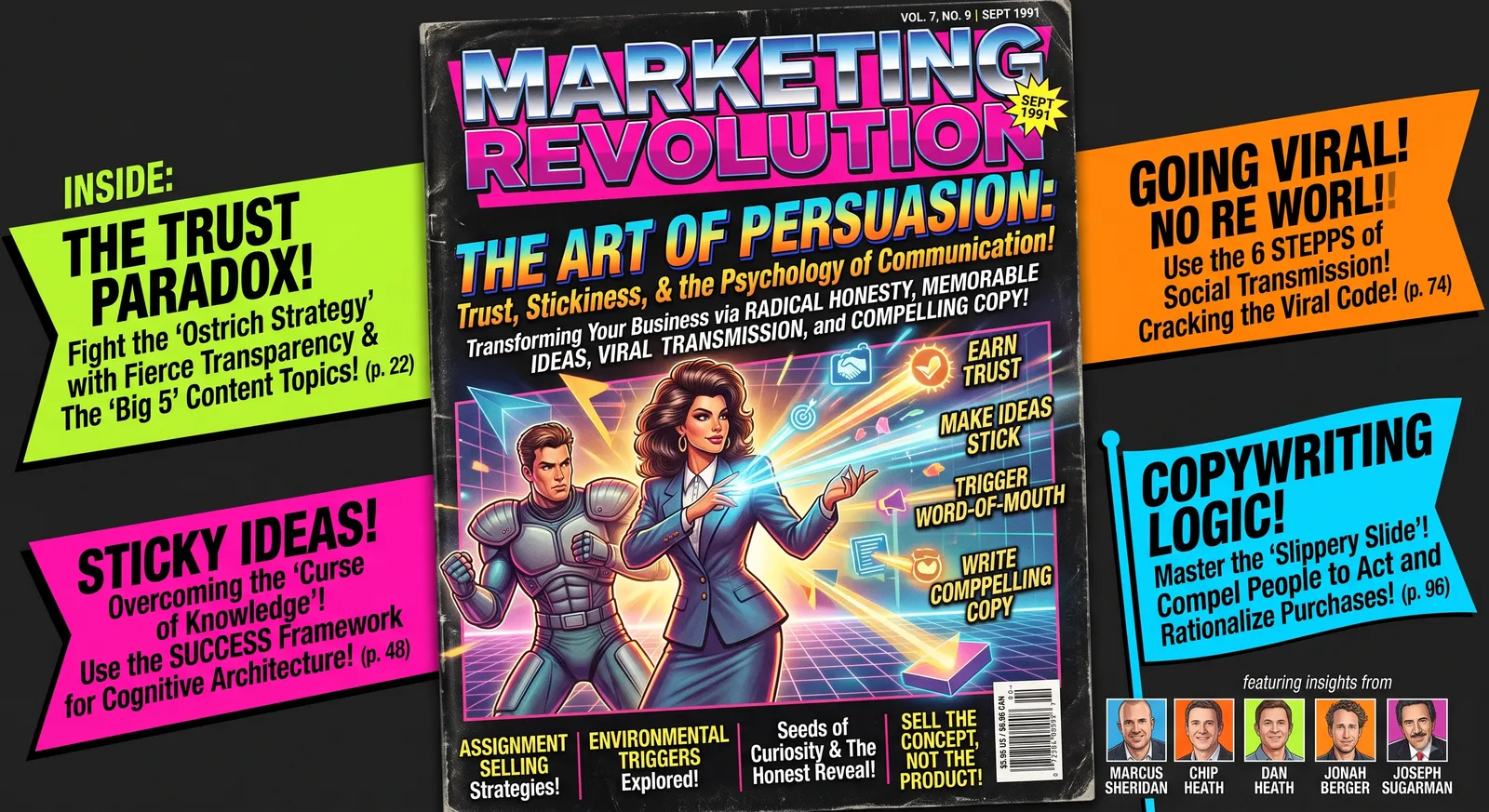
Four paradigms of persuasion: trust, stickiness, word-of-mouth and the slippery slide
Most communication advice is a list of tactics with no theory behind it. These four frameworks are different. Each one explains why a message works, and each one comes from a book that has survived long enough to be worth borrowing from.
They also stack. Trust gets someone to listen. Stickiness keeps them holding on. Word-of-mouth makes them carry it further. And copywriting logic determines whether they ever get past your first line.
Paradigm 1: The trust paradox — honest inbound sales
The theory
Trust is the most scarce and valuable asset in modern business. Traditional marketing often operates under an "ostrich strategy," where businesses hide prices, avoid discussing competitors, and sweep product limitations under the rug.
True brand disarmament happens when a business shifts its entire culture to a "teacher's mentality" — actively seeking out and answering the market's most difficult, uncomfortable, and ugly questions with fierce, unbiased transparency.
The practical showcase
This theory is executed via "The Big 5" content topics — the five areas consumers research most heavily before buying:
- Pricing and costs. Explain what drives costs up or down and where you sit in the market. Segue Technologies generated more than $8 million in revenue by being the first B2B tech firm in their niche to publish a genuinely transparent article answering "How Much Does It Cost to Build a Mobile App?"
- Problems. Turn weaknesses into strengths by addressing your industry's flaws openly. Smarter Finance USA built dominant industry trust by publishing articles exposing equipment leasing swindles, lies and scam techniques.
- Versus and comparisons. Provide unbiased head-to-head comparisons of your products versus alternatives.
- Reviews. Actively evaluate solutions in your space.
- Best in class. Highlight the top competitors in your field, even if you aren't on the list. Yale Appliance used this to generate millions, writing pieces like "The Least Serviced / Most Reliable Appliance Brands" to position themselves as the Yelp of appliances.
The strategic alignment
Implement assignment selling: have your sales team assign educational materials to prospects before a meeting. This filters out bad-fit prospects and makes sales calls productive, collaborative sessions rather than repetitive FAQs.
If you want to see this in practice rather than in theory, the case for publishing the answer nobody else will is a good place to start — it's the kind of question most businesses in that space quietly avoid.
Paradigm 2: Cognitive stickiness — overcoming the curse of knowledge
The theory
The greatest villain in communication is the Curse of Knowledge. Once you know an idea intimately, it becomes impossible to imagine what it was like not to know it. Experts naturally communicate in abstract, lifeless prose — "maximising shareholder value", "comprehensive community building" — which the human brain is not wired to remember.
The practical showcase
To bypass this barrier we use the SUCCESs framework to construct ideas that capture attention, are remembered, and drive action:
- Simple (find the core). Prioritise ruthlessly. Southwest Airlines famously uses the proverb "THE low-fare airline" to guide every employee decision.
- Unexpected (get and keep attention). Break a pattern to surprise the brain. To sustain interest, systematically open knowledge gaps — George Loewenstein's Gap Theory of Curiosity — by highlighting specific knowledge your audience is missing before you fill it.
- Concrete (help people understand). Explain abstract ideas in sensory, human terms. To show how unhealthy movie popcorn was, Art Silverman laid out the fat content of one bag next to a full day of greasy food — eggs, steak, a Big Mac — turning abstract numbers into a vivid image.
- Credible (help people believe). Use an "anti-authority," like real-life smoker Pam Laffin showing her tracheotomy. Or pass the Sinatra Test — "if you can make it there, you can make it anywhere" — like a shipping company proving they'd handled the highly complex, time-sensitive delivery of the Harry Potter books.
- Emotional (make people care). Appeal to identity, not mere self-interest. Tap into Maslow's higher needs — learning, self-actualisation — rather than the basement of base security and wealth.
- Stories (spur to action). Use stories as mental flight simulators, showing people how context misleads and how resourceful people solve problems.
The strategic alignment
Structure over content. If your message isn't sticking, the problem is almost always structural, not factual. Use a puzzle, a mystery or a narrative arc to force the audience to ask the questions you want to answer.
We went deeper on this one separately — why some ideas stay walks through four stories that illustrate the framework, including the Darth Vader toothbrush.
Paradigm 3: The STEPPS of social transmission
The theory
Word-of-mouth is vastly more effective and targeted than traditional advertising, but it requires understanding the psychological triggers of social transmission. People don't share content simply because it's high quality. They share because sharing serves a social and psychological purpose for them.
The practical showcase
To make an idea, product or behaviour contagious, embed the six STEPPS:
- Social currency. We share what makes us look smart, cool or helpful. Please Don't Tell, a secret phone-booth bar, relies entirely on the social currency of feeling like an insider.
- Triggers. Environmental cues that keep a product top of mind and tip of tongue. Kit Kat revived their brand by linking the candy bar to coffee, growing its daily habitat.
- Emotion. High-arousal emotions — awe, anger, anxiety, excitement — drive sharing. Low-arousal emotions like sadness and contentment suppress action.
- Public. "Built to show, built to grow." Private choices must be made public to drive imitation — Movember's moustache, Apple's white headphone cords.
- Practical value. Highly packaged, useful, news-you-can-use. Short, structured, actionable lists.
- Stories. Embed your core message inside a Trojan Horse narrative people actually want to pass along, where the product is integral to the plot.
The strategic alignment
Focus on environmental triggers. A highly interesting but untriggered product will fail to sustain word-of-mouth compared to a slightly more mundane but heavily triggered one. Cheerios beats Disney World on this measure, precisely because you eat breakfast every day.
Paradigm 4: Copywriting logic — the slippery slide
The theory
Copywriting is an exercise in psychological momentum. Every component of an advertisement — headline, subheadline, photo, caption — has one primary purpose: to get the prospect to read the very first sentence of your copy. Once they read the first sentence, they must be swept up in curiosity, compelled to slide down the copy as if on a slippery slide.
The practical showcase
- Sell the concept, not the product. Frame the offering as an inviting concept or dream.
- Seeds of curiosity. Keep readers sliding by ending paragraphs with short, curiosity-inducing phrases — "but more on that later", "let me explain".
- Logical justification. People buy on emotion but must rationalise with logic. Your copy needs the specs, detail and value-proofs so a prospect can defend their emotional decision to themselves and to others.
The strategic alignment
The honest reveal. Don't shy away from your product's flaws. Highlighting your primary limitation up front establishes immediate, shocking credibility — which makes every subsequent positive claim far more believable.
How these four fit together
Read them as a sequence rather than a menu:
| Paradigm | What it solves | When you use it |
|---|---|---|
| Trust paradox | Why should they listen to you at all? | Before everything else |
| Cognitive stickiness | Why will they remember? | When you're writing the message |
| STEPPS | Why would they share it? | When you want reach beyond your audience |
| Slippery slide | Why will they keep reading? | When you're structuring the page |
The order matters. A perfectly structured slippery slide on a message nobody trusts is wasted craft. Trust first, then form.
If you want the practical version of all four applied to a specific business problem, the five email workflows that make money is where the theory actually gets used.
Why we care about this
We build automation for social media and email marketing — both of which fail in exactly the same way when these paradigms are ignored. A perfectly scheduled post that says nothing concrete still says nothing. A personalised email built on a curse-of-knowledge message still doesn't land.
The tools are the easy part. The message is the work. See how we approach it if you'd rather someone else handle the whole thing.
Sources
- They Ask, You Answer: A Revolutionary Approach to Inbound Sales, Content Marketing, and Today's Digital Consumer by Marcus Sheridan — Amazon
- Made to Stick: Why Some Ideas Survive and Others Die by Chip Heath & Dan Heath — Amazon
- Contagious: Why Things Catch On by Jonah Berger — Amazon
- The Adweek Copywriting Handbook by Joseph Sugarman — Goodreads
- The Psychology of Curiosity: A Review and Reinterpretation by George Loewenstein, Psychological Bulletin, 1994, Vol. 116, No. 1, pp. 75–98 — PDF (Carnegie Mellon University)
Last updated: September 2026.