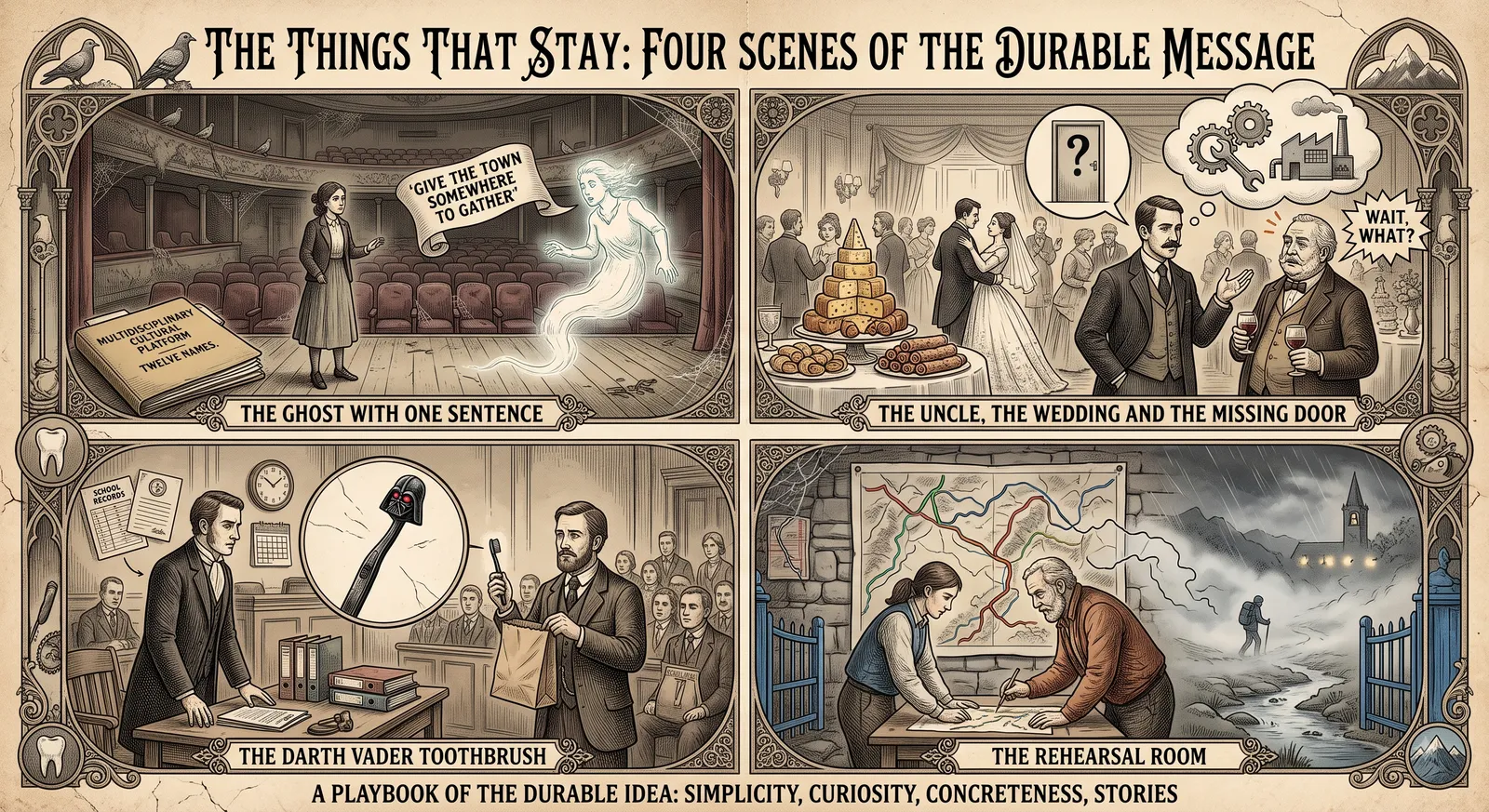
Some ideas pass through the mind like birds seen from a train: visible for a moment, then gone. Others settle there. They acquire a shape, a sound, perhaps even a smell. Long after the speaker has stopped talking, they remain.
The difference is rarely intelligence. It is usually form. An idea must become something a person can see, repeat, question or quietly practise.
The ghost with one sentence
At the edge of a small town stood an abandoned theatre. Its roof leaked, its velvet seats had faded to the colour of old wine and pigeons nested above the stage.
One winter morning, a young director entered with a proposal to restore it. Her folder contained budgets, architectural drawings, attendance forecasts and twelve possible names for the new arts centre.
The town committee listened for two hours.
When they asked what the theatre was for, she opened the folder again.
That night, alone on the stage, she imagined the building after its death. The roof had collapsed. The seats had been taken away. The posters had turned to dust. If the theatre returned as a ghost, what would it say before disappearing?
She waited in the dark.
At last, the answer came:
"Give the town somewhere to gather."
The next morning, she removed most of the pages from her folder. She kept the drawings, but changed the proposal. The theatre would not be "a multidisciplinary cultural platform". It would be the place where the town gathered: for films, plays, school concerts, winter markets and funerals when the church was full.
The committee approved the plan.
The ghost test asks an idea to survive without its decorations. If it can return from the dead in one clear sentence, it has found its centre. Simplicity is not making an idea smaller; it is discovering what everything else is meant to serve.
The uncle, the wedding and the missing door
At his niece's wedding, a young engineer was cornered by his uncle beside a pyramid of cheese.
"So what is it you do?" the uncle asked.
The engineer began with machine learning, then moved to predictive systems, data pipelines and industrial optimisation. His uncle nodded gravely while watching a waiter carry away the last of the sausage rolls.
The engineer stopped and tried again.
"I help factories notice when a machine is about to break."
His uncle turned towards him.
"Before it breaks?"
"Before it breaks."
"Wait, what?"
That was the moment the engineer realised he had finally been understood. His uncle was no longer being polite. He wanted to know how.
The engineer explained that the system listened for small changes in vibration, much as a doctor might notice an unusual heartbeat. The uncle leaned closer. By the time the bride and groom began their first dance, he was asking whether the system could detect problems in his lawnmower.
The drunk-uncle-at-a-wedding test is a test of plain speech, not of anyone's intelligence. The phrase "Wait, what?" is equally valuable: it marks the instant when an ordinary expectation breaks and curiosity enters. First make the idea clear enough to grasp; then give the listener a reason to keep holding it.
The Darth Vader toothbrush
A father arrived late to the hearing carrying a paper bag from a chemist.
Inside it was a toothbrush.
It was black, slightly bent and shaped like Darth Vader. One of the red eyes had been scratched away.
The lawyer had prepared a careful description of the father's involvement in his daughter's daily life. There were calendars, school records and statements from neighbours. All of it was accurate. None of it seemed to breathe.
Then the father explained the toothbrush.
His daughter refused to brush her teeth unless Darth Vader did it with her. Every morning, the father stood beside the basin and supplied the voice.
"Luke," he would say, in a terrible imitation of James Earl Jones. "Use the toothpaste."
The child would laugh, brush her teeth and spit foam into the sink.
The room changed. The father was no longer an abstract figure described as "engaged" or "supportive". He was standing in a bathroom before school, performing the voice of a fictional villain for a child who did not want to brush her teeth.
The scratched red eye said more than the calendar.
Concrete details give an idea somewhere to live. A claim such as "he is an attentive parent" floats above the ground; a damaged Darth Vader toothbrush sits beside the sink. The mind remembers what it can picture, touch and place inside an ordinary human moment.
The rehearsal room
In a mountain rescue station, a new volunteer was shown a map covered with coloured lines. The instructor explained routes, distances, weather patterns and emergency procedures. By the end of the afternoon, the volunteer could repeat every rule.
That evening, during a storm, a call came from a hiker who had lost the path.
The volunteer looked at the map and froze.
An older rescuer took a pencil and drew a small circle near a stream.
"Last year," she said, "a man called from here. He could see the lights of the village, but every time he walked towards them, the fog turned him around. He followed the stream downhill instead. It led him to a fallen gate. The gate was painted blue. From there, he could hear the church bell."
The volunteer looked again at the map.
This time, it was no longer a collection of lines. There was the stream, the fog, the gate and the bell. He could imagine the lost man moving through the darkness. He could also imagine where the wrong turn would begin.
They found the hiker before midnight.
Years later, the volunteer could no longer remember every instruction from that first afternoon. He remembered the blue gate.
Stories are rehearsal rooms for action. They allow us to enter a difficult situation before it arrives, make mistakes without paying their full price and notice the detail that changes everything. A good idea does not merely tell us what is true; it lets us practise what we might do.
What this has to do with marketing
This is the part most businesses get backwards. They describe what they are rather than what a customer would see.
"A multidisciplinary cultural platform" is the folder. "Somewhere to gather" is the theatre. One of those gets approved and remembered; the other gets politely nodded at and forgotten by the following morning.
The same thing happens in marketing every week. "We're an AI-powered marketing automation platform" travels no further than the engineer's data pipelines did. What travels is: your leads get followed up, your invoices go out, and your calendar stays full. No technology named. No folder opened.
If you're trying to work out whether your own positioning passes the ghost test, the honest version is that selling an outcome beats selling the technology — it's the pattern that showed up again and again in hundreds of replies from people who'd actually made it work.
And the concrete detail is what turns a claim into something a customer can hold. Not "we personalise your campaigns" but "welcome Sarah, and mention something from her company's website." The scratched red eye, not the calendar.
Once an idea becomes a place we can enter, it is much harder to lose.
Why we write about this
We build automation for social media and email marketing — tools that are meant to help a small business sound like itself, not like a platform. Which is why the ghost test matters to us. We'd rather be the theatre the town gathers in than the folder nobody opens.
If you want the longer version of how that thinking shapes what we make, see why businesses choose Fismbot over agency retainers.
Sources: Chip Heath, Dan Heath — Made to Stick: Why Some Ideas Survive and Others Die